
by Mano Capano, Pivoines Capano
'Bartzella' is a member of the all-new select club of intersectional, or Itoh, peonies, those famous peonies resulting from a cross between a herbaceous peony and a tree peony. Bartzella is part of the intersectional peony generation created by Roger Anderson of Wisconsin. Recently available on the market, these peonies are of an exceptional beauty and possess such characteristics that explain their high price. These are the peonies of the future.
Bartzella has luminous yellow flowers. A real yellow. The interior of the flower is splashed with red, creating a superb contrast with the yellow. When Bartzella is in flower, she dethrones all the others. Imagine an enormous yellow flower, the size of a pie plate, held well above magnificent foliage on solid stems, without any support. Imagine more than thirty such flowers on the same plant. Without a doubt, it is Bartzella who gets all the attention. It is a top model peony. Tall and naturally distinguished, it is a dream peony.
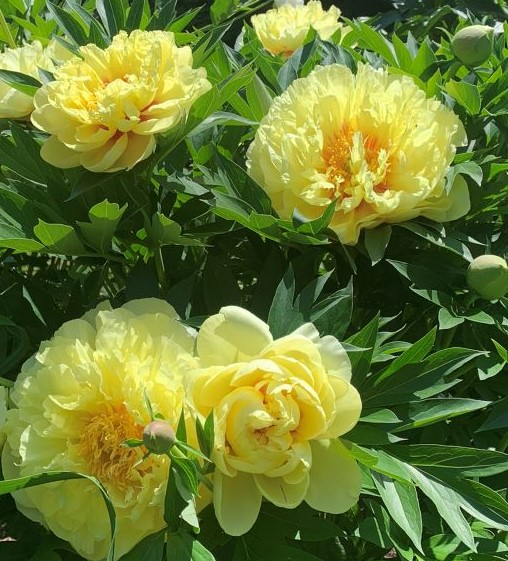
Bartzella produces numerous secondary flowers; though slightly smaller than the main flower, they are nonetheless spectacular. These secondary flowers are what explain the long flowering period of Bartzella, which can be as long as three weeks, beginning in mid-season and ending at the same time as the late-blooming peonies.
Bartzella is vigorous and hardy to at least Zone 3. After three years of growing here in Chicoutimi, the plant looks like a small shrub more than a meter in circumference and easily exceeding a meter in height. The foliage is typically that of a tree peony, but it is glossy when tree peony foliage is matte. Even after flowering, the foliage remains good and solid until well into the autumn, and the flowers are very fragrant with an agreeable hint of lemon.
Bartzella's characteristics led to it being awarded the title of Grand Champion during the 97th annual show of the American Peony Society in June 2002. Bartzella is a specimen plant. It should be used as a star in the landscape because it certainly deserves its title of Queen of the peonies!
Note: This article was originally posted on the Canadian Peony Society Blogger Blog on May 10, 2005. As part of a preservation project, these posts are now being re-published on the CPS website. All credit belongs to the original author, as indicated when this information is available. New photo added in 2026 by Céline Arseneault.